Smart Power Hubs for Astrophotography: Pegasus Guide
By DeepField · 9 min read · Updated June 2026
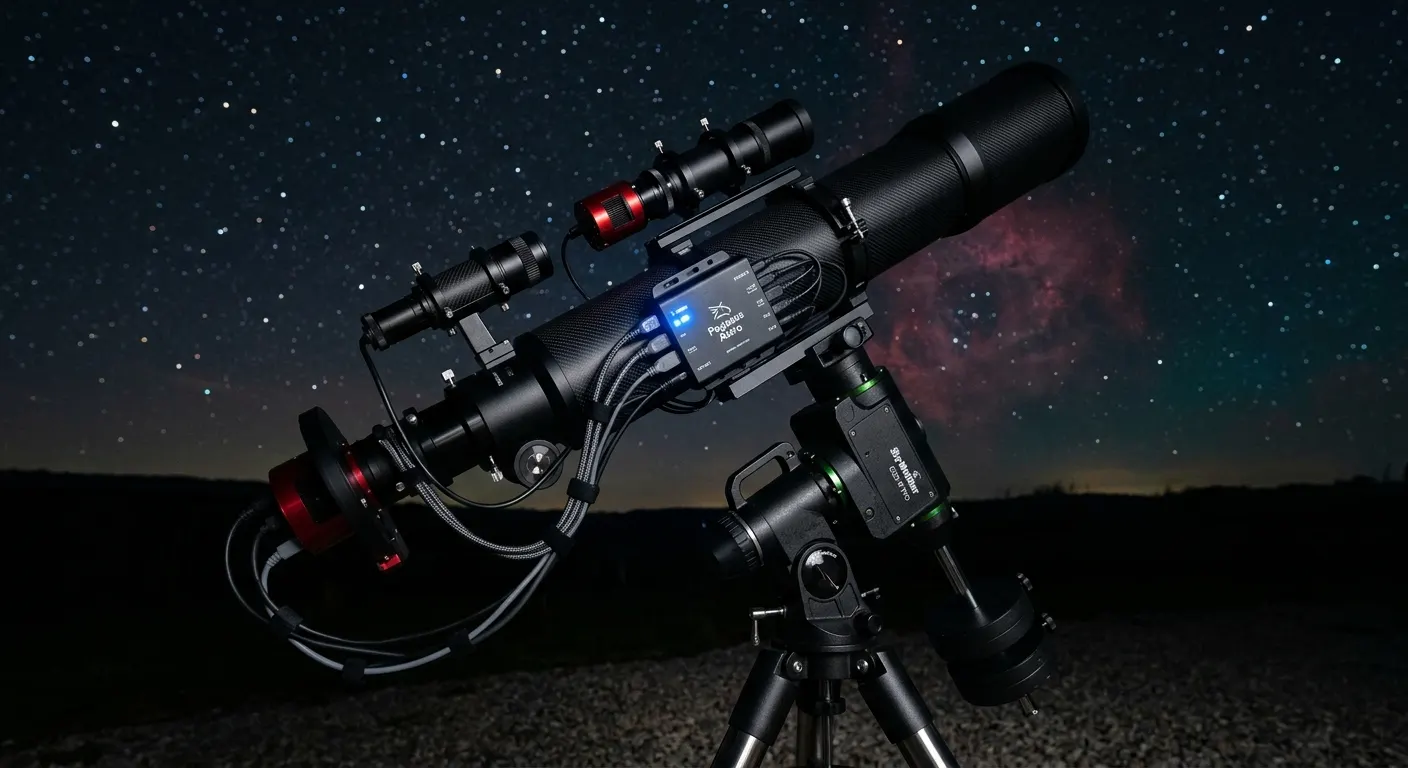
Power management is the unsexy problem that every serious astrophotographer eventually has to solve. A full imaging rig with a GoTo mount, imaging camera, guide camera, dew heaters, electronic focuser, USB hub, and controller draws forty to a hundred watts from a tangle of cables that is a failure point waiting to happen. A smart power hub replaces that tangle with a single device that distributes regulated 12V power to every component, switches channels on and off from software, and monitors current draw per output. The Pegasus Astro Ultimate Powerbox v3 is the gold standard for observatory and balcony setups. The Pegasus Astro Pocket Powerbox Advance Gen2 is the compact alternative for portable and rooftop rigs. Here is why these devices matter and how to set them up.
Quick answer
The Pegasus Astro Ultimate Powerbox v3 is the best smart power hub for a permanent or semi-permanent astrophotography setup, providing software-controlled 12V outputs, integrated dew heater channels, and deep integration with NINA and Sequence Generator Pro. For portable setups, the Pocket Powerbox Advance Gen2 provides the same functionality in a compact form that mounts directly on the telescope tube.
This guide contains affiliate links. DeepField may earn a commission at no cost to you.
What a smart power hub actually does
A smart power hub is a device that takes one input from your power source and distributes regulated 12V through multiple individually switchable and monitorable outputs. Each output channel can be switched on or off from software, and many hubs also report the current draw per channel in real time. This means you can see exactly how much power each device is drawing and turn channels off remotely when a device is not in use.
The practical benefits are significant. Cable management goes from a chaotic web to a single power cable in and individual cables from the hub to each device. If a device draws abnormally high current, the software alert catches it before it trips a fuse or causes a fault. Sequences in NINA or Sequence Generator Pro can include power-on and power-off events for specific channels, so a camera warms up automatically at the end of a session without you needing to go back to the telescope.
Beyond pure power distribution, devices like the Pegasus Astro Ultimate Powerbox v3 include integrated USB 3.0 and USB-C hubs, so all the USB connections for cameras, mount, focuser, and guide camera also consolidate through one device rather than a separate powered USB hub.

Pegasus Astro Ultimate Powerbox v3
A smart power hub and USB controller that distributes regulated 12V power to mounts, cameras, dew heaters, and focusers through software-controlled outputs, with current monitoring and scripting via the Pegasus Unity Platform.
Ultimate Powerbox v3 versus Pocket Powerbox Advance Gen2
The Pegasus Astro Ultimate Powerbox v3 is designed for observatory and balcony setups where the mount stays in place between sessions and the power hub mounts permanently to the pier or the mount head. It offers more output channels, higher per-channel current capacity, and deeper software scripting integration with NINA via the Pegasus Unity Platform driver. If you run a complex rig with many powered accessories and want maximum automation capability, this is the correct choice.
The Pegasus Astro Pocket Powerbox Advance Gen2 is the compact version for portable and rooftop imaging setups. It mounts directly to the optical tube OTA via a dovetail mount or clamp, weighs significantly less, and fits in a carry-on bag for travel setups. It provides four regulated 12V outputs, integrated USB ports, and built-in dew heater channels controlled via the same Pegasus Unity software. The output current capacity per channel is lower than the full UPBv3, so it is not suitable for very high-draw accessories.
For most portable and rooftop setups, the Pocket Powerbox covers everything a typical rig needs. The full UPBv3 is justified when you have more than four high-draw powered accessories or want the maximum software scripting depth.
Pegasus Astro Ultimate Powerbox v3
A smart power hub and USB controller that distributes regulated 12V power to mounts, cameras, dew heaters, and focusers through software-controlled outputs, with current monitoring and scripting via the Pegasus Unity Platform.
Pegasus Astro Pocket Powerbox Advance Gen2
A compact field power hub with four 12V outputs, USB 3.0 ports, and a built-in dew heater controller that gives you smart power management in a pocket-sized box for travel rigs.
Integrating with NINA for scripted power management
NINA (Nighttime Imaging in Astronomy) supports the Pegasus Powerbox family natively through the Pegasus Unity Platform ASCOM and INDI drivers. Once connected, you can include power management events directly in your imaging sequence: turn on the dew heater for the flat panel before capturing calibration frames, turn off the imaging camera after the sequence completes to allow it to warm up before disconnection, or monitor the mount motor current draw throughout the night.
The most practical automation for most users is the dew heater scheduling. Set the dew heater channels to run at 30 to 50 percent at the start of the sequence and increase automatically as the temperature sensor reads a lower ambient temperature later in the night. The Pegasus Astro DewMaster 2 Digital Dew Controller does this with its own built-in intelligence, but when the DewMaster is not in the budget, connecting budget dew heater strips to the Powerbox's dew heater outputs and controlling them from NINA serves the same purpose.

Pegasus Astro DewMaster 2 Digital Dew Controller
A five-channel PWM dew heater controller with a built-in temperature and humidity sensor, USB-C, and Wi-Fi for full software automation of dew prevention across an entire imaging rig.
ASIAIR and Pocket Powerbox: the portable combo
The ZWO ASIAIR Plus 256GB Wi-Fi Imaging Controller and the Pocket Powerbox Advance Gen2 are the two most popular compact controllers for travel and rooftop setups, and they complement each other well. The ASIAIR handles imaging, guiding, and plate solving. The Pocket Powerbox handles power distribution, USB consolidation, and dew heater control. Both mount to the telescope tube and connect to each other via a single USB cable, keeping the overall cable count minimal.
For setups that add an ZWO EAFN Electronic Automatic Focuser (2025) , the ASIAIR connects to the focuser directly and the Powerbox supplies 12V power to both the ASIAIR and the focuser. The result is a self-contained imaging system on the tube with a single 12V input cable from the portable power station.

ZWO ASIAIR Plus 256GB Wi-Fi Imaging Controller
An all-in-one Raspberry Pi-based imaging controller that connects ZWO cameras, a GoTo mount, EAF autofocuser, and guide camera through a single device controlled from a phone app, eliminating the laptop entirely.
ZWO EAFN Electronic Automatic Focuser (2025)
A fifth-generation electronic autofocuser with a 5 kg load capacity, USB-C connection, and native ASIAIR and NINA support, allowing software-driven automatic focus routines during an imaging session.
What to look for in a 12V power source for the field
The power hub is only as good as the 12V source feeding it. For portable setups, a lithium iron phosphate (LiFePO4) portable power station in the 500 to 1000 Wh range is the current standard. LiFePO4 chemistry handles cold temperatures better than standard lithium-ion cells and delivers stable voltage under load, which matters for mount tracking accuracy.
Run a real power draw test before your first remote dark sky session: connect everything through the power hub with the current monitoring active and record the actual draw at typical dew heater power settings. This measured draw, not an estimated one, tells you exactly how many hours your battery will last under real conditions. These figures vary significantly depending on ambient temperature and which accessories you run; the only reliable number is your own measured draw.
Featured in this guide
Pegasus Astro Ultimate Powerbox v3
A smart power hub and USB controller that distributes regulated 12V power to mounts, cameras, dew heaters, and focusers through software-controlled outputs, with current monitoring and scripting via the Pegasus Unity Platform.
Pegasus Astro Pocket Powerbox Advance Gen2
A compact field power hub with four 12V outputs, USB 3.0 ports, and a built-in dew heater controller that gives you smart power management in a pocket-sized box for travel rigs.
Pegasus Astro DewMaster 2 Digital Dew Controller
A five-channel PWM dew heater controller with a built-in temperature and humidity sensor, USB-C, and Wi-Fi for full software automation of dew prevention across an entire imaging rig.
ZWO ASIAIR Plus 256GB Wi-Fi Imaging Controller
An all-in-one Raspberry Pi-based imaging controller that connects ZWO cameras, a GoTo mount, EAF autofocuser, and guide camera through a single device controlled from a phone app, eliminating the laptop entirely.
ZWO EAFN Electronic Automatic Focuser (2025)
A fifth-generation electronic autofocuser with a 5 kg load capacity, USB-C connection, and native ASIAIR and NINA support, allowing software-driven automatic focus routines during an imaging session.
Related roundups
FAQ
Frequently asked questions
Do I need a smart power hub or can I just use a power strip?+
A power strip works but gives up every benefit of a smart hub. With a smart hub, you can monitor current draw per channel, switch devices on and off from software, automate power events in imaging sequences, and consolidate USB connections in one device. The cable management alone justifies the cost for a complex rig. A standard power strip works for basic setups but becomes limiting once you have more than three or four powered accessories.
Is the Pegasus Ultimate Powerbox v3 worth the price?+
For a dedicated observatory or balcony rig running NINA with a complex multi-device setup, yes. The per-channel power monitoring, scripted automation, USB consolidation, and deep NINA integration make it the most capable power management solution for serious imaging. For a simpler or more portable setup, the Pocket Powerbox Advance Gen2 at a lower price provides the same core functionality with fewer channels and lower per-channel capacity.
Can the Pocket Powerbox power a large GoTo mount?+
The Pocket Powerbox Advance Gen2 has a total output current capacity that should be checked against your mount's peak current draw before ordering. Most mid-sized GoTo mounts like the Sky-Watcher EQ6-R Pro draw 1 to 2 amps during slewing and less during tracking. The Pocket Powerbox handles typical mounts of this class, but very heavy GEM mounts with large motor assemblies or direct-drive systems should be checked against the specific current specification. The Pegasus website publishes the current limits for each model.
How does the dew heater control in a smart powerbox compare to a dedicated dew controller?+
A smart powerbox with dew heater outputs provides manual and software-schedulable PWM control through the same Unity Platform interface used for power management. A dedicated dew controller like the Pegasus DewMaster 2 adds a built-in temperature and humidity sensor that automatically adjusts heater power based on actual atmospheric conditions without requiring software commands. For a laptop-free ASIAIR setup or a simpler rig, powerbox dew heater channels are sufficient. For a fully automated NINA observatory setup with unattended operation, the dedicated DewMaster's sensor-driven automation is the more reliable option.