Building a Portable Astrophotography Rig for Travel
By DeepField · 10 min read · Updated June 2026
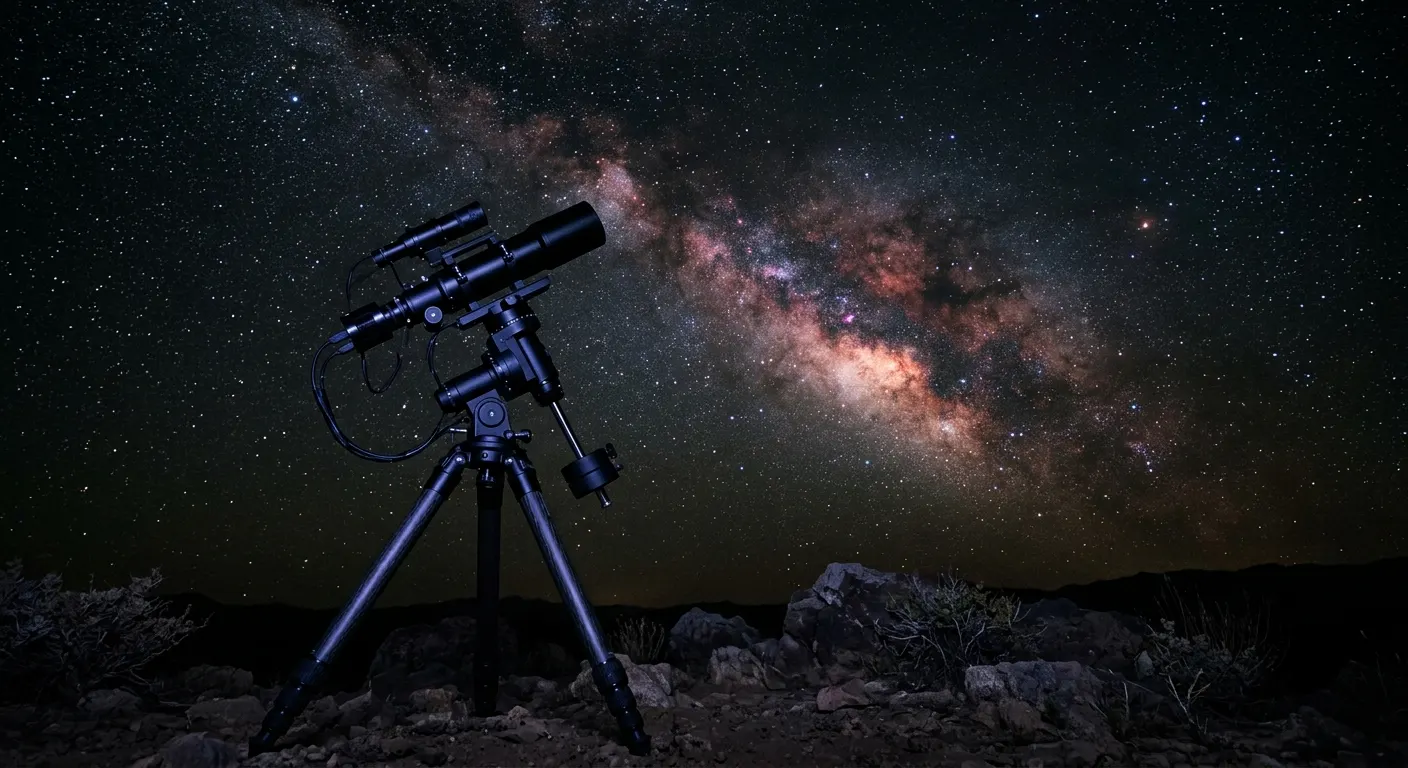
A portable astrophotography rig is not a compromise version of a home setup. It is a different kind of system optimized for a different kind of imaging: dark sky access, rapid setup, and airline-checkable weight limits. The goal is to carry everything in two bags while losing none of the core imaging capability. For Milky Way and wide-field photography, a star tracker like the Sky-Watcher Star Adventurer 2i Pro Pack on any carbon-fiber tripod is the simplest path. For deep-sky work with guided exposures from dark sites, the ZWO AM5N Harmonic Drive Equatorial Mount with a small refractor fits the travel brief better than anything in the German equatorial class. Here is how to plan and pack a portable rig.
Quick answer
For wide-field Milky Way work, the Sky-Watcher Star Adventurer 2i or iOptron SkyGuider Pro on a travel tripod is the correct portable solution, weighing under three pounds for the drive head and fitting in carry-on luggage. For guided deep-sky imaging at dark sites, the ZWO AM5N harmonic mount carries 28 lbs without a counterweight in a compact 12-pound package.
This guide contains affiliate links. DeepField may earn a commission at no cost to you.
Two approaches to portable astrophotography
Wide-field Milky Way photography and deep-sky guided imaging have different requirements, and the right portable solution depends on which one you are optimizing for. Wide-field work with a DSLR or mirrorless and a 14 mm to 50 mm lens needs a simple star tracker that provides accurate RA tracking on a photo tripod. Deep-sky work with a 300 mm to 800 mm focal length scope needs a proper GoTo mount with enough payload for a full imaging rig.
For wide-field travel, the Sky-Watcher Star Adventurer 2i Pro Pack weighs under three pounds for the drive head and mounts to any photo tripod with a ball head. It handles a DSLR with a 200 mm telephoto lens reliably, which covers most wide-field Milky Way compositions. The built-in Wi-Fi allows control via the SynScan app so you can adjust tracking from your phone without touching the mount.
The iOptron SkyGuider Pro Camera Mount is the direct competitor and differentiates itself with a built-in illuminated polar scope and a fine-adjustment declination bracket for precise framing correction. For photographers who value the built-in polar scope over the Star Adventurer's Wi-Fi and prefer a slightly more rigid construction, the SkyGuider Pro is the alternative worth evaluating.
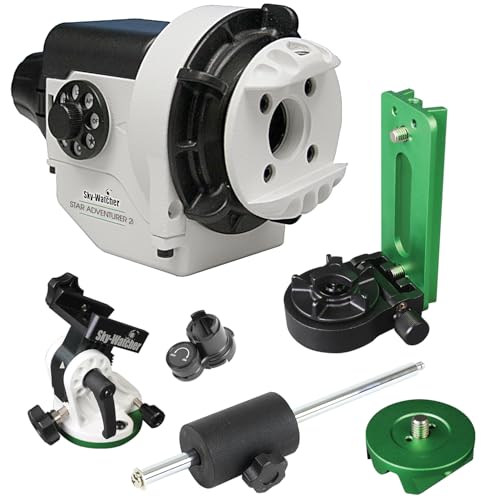
Sky-Watcher Star Adventurer 2i Pro Pack
An 11 lb payload star tracker that mounts to any photo tripod and provides accurate RA tracking for wide-field and telephoto astrophotography on the road.

iOptron SkyGuider Pro Camera Mount
An 11 lb payload tracker with a built-in polar illuminator, fine RA adjustment knob, and a declination bracket that allows precise framing corrections.
The portable deep-sky solution: ZWO AM5N harmonic mount
The ZWO AM5N Harmonic Drive Equatorial Mount represents a new category for travel deep-sky imaging: a full GoTo mount with 28 lb payload capacity that weighs only 12 lbs and does not require a counterweight on most typical small-to-medium refractors. Harmonic drive mounts use a wave-generator mechanism instead of a traditional gear train, which gives them exceptional compactness for their payload.
For a travel rig built around a small apochromatic refractor in the 60 mm to 80 mm range, a ZWO ASI camera, and a guide camera, the AM5N comfortably handles the payload and fits in check-in luggage when packed in a hard case. The entire imaging rig including the mount, tripod, telescope, and accessories can weigh under 25 lbs, which compares favorably with a traditional German equatorial mount of equivalent payload.
The one practical caution for harmonic mounts: they are more sensitive to balance than traditional GEM mounts. The wave-generator mechanism does not tolerate a strongly front-heavy optical tube as well as a counterweighted GEM. Balance your OTA within a few inches of center before imaging, and the AM5N performs beautifully.

ZWO AM5N Harmonic Drive Equatorial Mount
A compact harmonic-drive GoTo mount that carries 28 lbs without a counterweight, weighs only 12 lbs, and delivers sub-10 arcsecond periodic error straight from the factory.
Laptop-free control for travel setups
Carrying a laptop to a dark sky site adds weight, needs its own power, and is a frustrating single point of failure in cold or damp conditions. The ZWO ASIAIR Plus 256GB Wi-Fi Imaging Controller eliminates the laptop entirely, controlling the ZWO camera, mount, guide camera, and autofocuser from a phone or tablet app. For a portable rig where simplicity and low power draw matter, the ASIAIR Plus is practically the default controller.
Power management at a remote site matters just as much as at home. The Pegasus Astro Pocket Powerbox Advance Gen2 handles this in a compact form factor, distributing regulated 12V from your portable power station to every device in the rig through individually controlled output channels. It mounts directly to the optical tube and includes built-in dew heater channels, which keeps the cable count low on a travel setup.

ZWO ASIAIR Plus 256GB Wi-Fi Imaging Controller
An all-in-one Raspberry Pi-based imaging controller that connects ZWO cameras, a GoTo mount, EAF autofocuser, and guide camera through a single device controlled from a phone app, eliminating the laptop entirely.

Pegasus Astro Pocket Powerbox Advance Gen2
A compact field power hub with four 12V outputs, USB 3.0 ports, and a built-in dew heater controller that gives you smart power management in a pocket-sized box for travel rigs.
Dew prevention at remote dark sky sites
Remote dark sky sites are often in valleys, meadows, or other low-lying terrain where dew forms aggressively. The radiative cooling that makes these sites dark also makes dew more likely because clear skies mean there is nothing to return heat to the ground. A travel rig without dew prevention often loses its first remote session to a fogged lens at 1 AM.
The Pegasus Astro DewZap Dual-Channel Dew Controller is compact enough for a travel kit and provides two independently controlled PWM channels for the main scope and the guide scope. For a simpler single-scope setup, the Dew-Not Dew Heater Strips (Various Sizes) paired with a basic analog controller like the Dew-Buster DB-1 Dual-Channel Dew Controller is the lightest and cheapest approach that still provides real dew control.
In exceptionally humid coastal locations, a dew shield that extends the barrel of the telescope objective slows radiative cooling and reduces the power the heater needs to maintain temperature. Many refractors ship with a dew shield; if yours did not, a slip-on dew shield extension is an inexpensive addition to the travel kit.

Pegasus Astro DewZap Dual-Channel Dew Controller
A compact two-channel PWM dew controller from Pegasus Astro with per-channel adjustment knobs and the same build quality as the DewMaster at a lower price.
Dew-Not Dew Heater Strips (Various Sizes)
An affordable dew heater strip range with velcro attachment and a standard RCA phono connector, compatible with all major dew controllers and sized for objectives from 1.25 inches to 12 inches.
Dew-Buster DB-1 Dual-Channel Dew Controller
A simple two-channel dew controller with manual rheostat adjustment that has been a reliable budget alternative to Pegasus and Kendrick controllers for over a decade.
Packing the rig: weight and airline limits
The most practical portable astrophotography travel list for a full deep-sky rig is: harmonic mount and head (approximately 12 lbs), small apochromatic refractor (approximately 5 to 8 lbs), camera and guide camera (under 2 lbs combined), ASIAIR controller, dew heater controller and strips, power distribution box, cables, and an intervalometer or remote shutter cable. This fits in a checked hard-sided case under 50 lbs on most airlines.
Carbon fiber tripods save roughly two to three pounds over aluminum, which matters when the total system is pushing against baggage limits. A lightweight ballhead that can also serve as the mount's alt-azimuth adjustment platform reduces the adapters needed for both the tracker and the tripod.
For carry-on imaging at Milky Way sites, the Star Adventurer 2i, a ballhead, and a mirrorless camera with two lenses fit in a single carry-on with room for clothing. This is the absolute minimal system that still produces tracked multi-minute exposures.
Featured in this guide
Sky-Watcher Star Adventurer 2i Pro Pack
An 11 lb payload star tracker that mounts to any photo tripod and provides accurate RA tracking for wide-field and telephoto astrophotography on the road.
iOptron SkyGuider Pro Camera Mount
An 11 lb payload tracker with a built-in polar illuminator, fine RA adjustment knob, and a declination bracket that allows precise framing corrections.
ZWO AM5N Harmonic Drive Equatorial Mount
A compact harmonic-drive GoTo mount that carries 28 lbs without a counterweight, weighs only 12 lbs, and delivers sub-10 arcsecond periodic error straight from the factory.
ZWO ASIAIR Plus 256GB Wi-Fi Imaging Controller
An all-in-one Raspberry Pi-based imaging controller that connects ZWO cameras, a GoTo mount, EAF autofocuser, and guide camera through a single device controlled from a phone app, eliminating the laptop entirely.
Pegasus Astro DewZap Dual-Channel Dew Controller
A compact two-channel PWM dew controller from Pegasus Astro with per-channel adjustment knobs and the same build quality as the DewMaster at a lower price.
Related roundups
FAQ
Frequently asked questions
What is the lightest mount for astrophotography while traveling?+
For wide-field Milky Way work, the Sky-Watcher Star Adventurer 2i drive head weighs under three pounds and fits in carry-on luggage. For guided deep-sky imaging with a full imaging rig, the ZWO AM5N harmonic mount weighs 12 lbs for the mount head without a counterweight and can carry a full imaging rig. Both are significantly lighter than a traditional German equatorial mount of equivalent payload.
Can I do guided deep-sky imaging from a dark sky campground?+
Yes, provided you have a portable power source and a mount capable of guided tracking. A harmonic drive mount like the AM5N, a small fast refractor, a ZWO ASI camera, and an ASIAIR controller can produce excellent deep-sky images from a dark sky campground running on a 500 to 1000 Wh power station. The key setup steps are careful polar alignment, guide scope dew prevention, and a stable tripod on firm ground.
Do I need a laptop for a portable astrophotography rig?+
Not if you use the ZWO ASIAIR Plus. It connects your camera, mount, guide camera, and autofocuser through a single device controlled from a phone or tablet app, handling polar alignment, plate solving, guiding, and capture without a laptop. For a travel rig, the ASIAIR is particularly valuable because it eliminates a heavy, fragile, high-power-draw device from the packing list.
Will dew be a problem at a dark sky site?+
Almost certainly yes. Dark sky sites are typically in low-lying terrain chosen for minimal light pollution, and these areas often have aggressive dew formation because clear nights cause strong radiative cooling and low-lying terrain collects moisture. Pack a dew heater for both the main objective and the guide scope as standard practice. The cost is minimal; the session-saving value is significant.