Field Flatteners and Coma Correctors: Spacing Setup
By DeepField · 10 min read · Updated June 2026
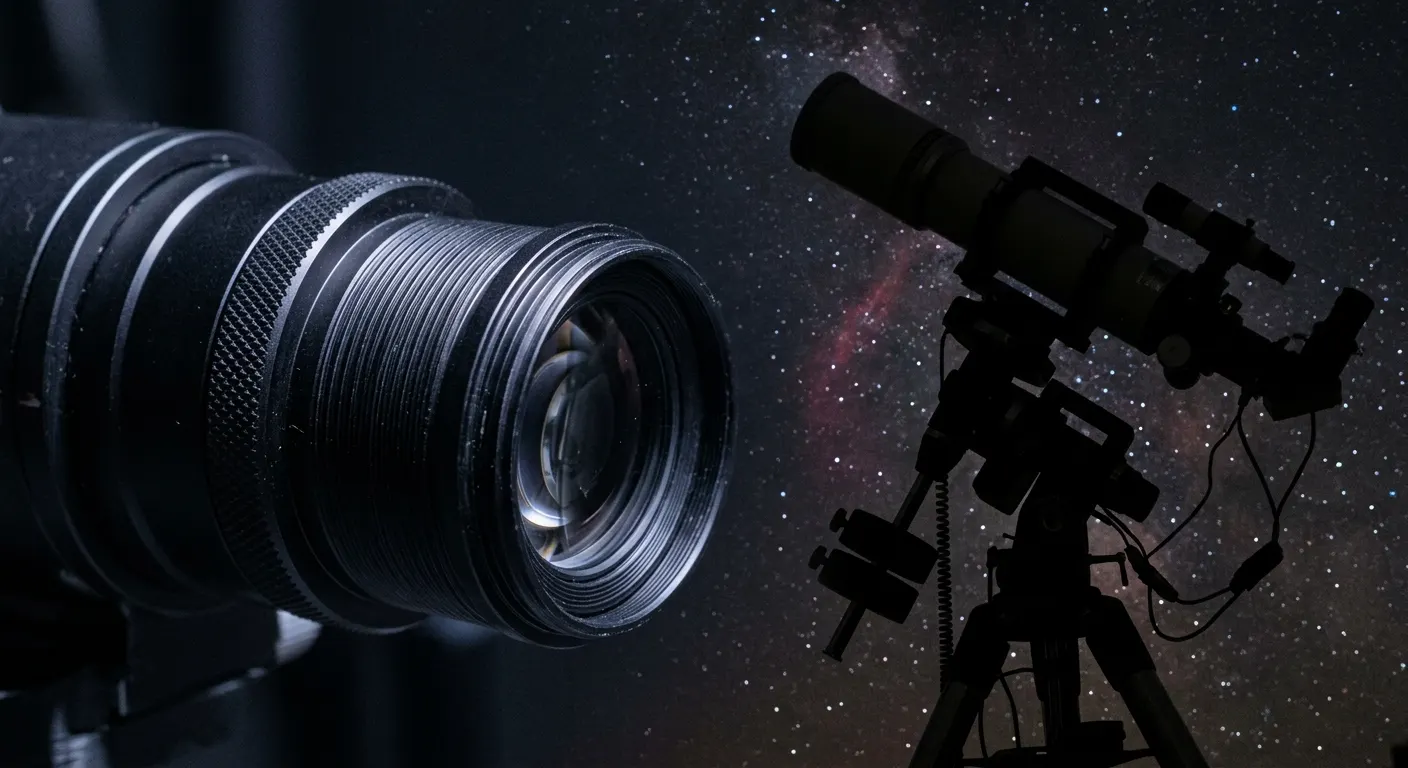
Corner star quality in a deep-sky image tells you almost everything about your optical train. Elongated stars that point away from center are the signature of field curvature on a refractor without a flattener. Seagull-shaped wings radiating outward from each corner star are the signature of coma in a fast Newtonian. Both problems have well-established solutions. For most ED refractors in the f/6 to f/7.5 range, the William Optics Flattener 68III for ED Refractors is the straightforward first choice. For f/4 to f/6 Newtonian owners, the Baader Multi-Purpose Coma Corrector MPCC Mark III is the community default. Getting the spacing right is the part that trips most people up, and this guide explains how to do it.
Quick answer
The William Optics Flattener 68III is the best choice for medium-speed ED refractors at f/6 to f/7.5, delivering flat corner stars across APS-C sensors. For f/4 to f/6 Newtonians, the Baader MPCC Mark III inserts directly into a 2-inch focuser and eliminates coma without altering the focal ratio. Both correctors require precise back-focus spacing, typically within a few millimeters of the manufacturer specification.
This guide contains affiliate links. DeepField may earn a commission at no cost to you.
Do you need a field flattener or a coma corrector?
The answer depends on your telescope type. Refractors and SCTs that show elongated corner stars pointing radially outward need a field flattener. Fast Newtonian reflectors that show wing-shaped or seagull-shaped distortions need a coma corrector. Some telescope designs, particularly fast f/4 imaging Newtonians, show both field curvature and coma, in which case a corrector that addresses both problems is the right choice.
The test: take a short test exposure on a star field, then zoom into the extreme corners. If the stars look like comets with tails pointing toward the image center, that is coma. If they look like short dashes elongated radially, that is field curvature. If they look like small circles in the center but blur into fans or ovals at the edge, that is a combination of both.
High-quality apochromatic triplet refractors with integral Petzval optics, like the Sky-Watcher Esprit series, often have built-in flattening but still benefit from the OEM-matched flattener like the Sky-Watcher Esprit 80ED Field Flattener when used with larger sensors. Standard ED doublets almost universally need a flattener for APS-C and full-frame sensors.

Sky-Watcher Esprit 80ED Field Flattener
The OEM matched field flattener for the Sky-Watcher Esprit 80ED triplet refractor, designed to extend the corrected image circle and provide flat stars on full-frame sensors.
Field flatteners for ED refractors
For William Optics ED doublets in the f/6 to f/7.5 range, including the Z61, Z73, and similar models, the William Optics Flattener 68III for ED Refractors is the most commonly recommended matched flattener. It is designed specifically for this focal ratio range and delivers flat stars across APS-C sensors with relatively low sensitivity to spacing error compared to some third-party alternatives.
For the Sky-Watcher Esprit 80ED, the Sky-Watcher Esprit 80ED Field Flattener is the OEM-matched option. It is designed for the Esprit's specific optical formula and is the correct first choice before trying any third-party flattener on that telescope.
Beginners on a tight budget who want to try a field corrector before investing in a matched premium option can start with the SVBONY SV193 0.8x Focal Reducer and Flattener , a 0.8x focal reducer-flattener for f/6 to f/9 refractors. Corner correction is not as precise as a matched flattener, but it demonstrates whether your sensor needs field correction and simultaneously widens your field of view and shortens required exposure times.
William Optics Flattener 68III for ED Refractors
A matched field flattener for William Optics and compatible ED refractors at f/6 to f/7.5, delivering flat stars edge to edge across APS-C and smaller sensors without altering focal length.
Sky-Watcher Esprit 80ED Field Flattener
The OEM matched field flattener for the Sky-Watcher Esprit 80ED triplet refractor, designed to extend the corrected image circle and provide flat stars on full-frame sensors.

SVBONY SV193 0.8x Focal Reducer and Flattener
A budget 0.8x focal reducer and field flattener for f/6 to f/9 refractors that widens the field of view and flattens corner stars simultaneously at an entry-level price.
Coma correctors for fast Newtonian reflectors
Fast Newtonian reflectors at f/4 to f/6 produce coma across a surprisingly small field. At f/4, the coma-free field is only a few millimeters in diameter, which means essentially every pixel on a large sensor is affected outside the very center. A coma corrector is not optional for imaging with a fast Newtonian; it is a requirement for anything other than planetary work.
The Baader Multi-Purpose Coma Corrector MPCC Mark III is the most widely used coma corrector in the f/4 to f/6 range. It threads onto a standard 2 inch focuser drawtube, requires minimal adaptation for most imaging setups, and delivers excellent correction on APS-C sensors. The two-element design shows some residual coma at the corners of full-frame sensors, but for APS-C and smaller it is highly capable.
For Sky-Watcher Quattro series owners and other dedicated imaging Newtonian users who want the best possible corner correction, the Sky-Watcher Quattro Coma Corrector (0.9x) with its four-element aplanatic design produces noticeably cleaner corners at the cost of a modest premium. It also includes a 0.9x focal reduction that slightly widens the field, which is useful on smaller sensors.

Baader Multi-Purpose Coma Corrector MPCC Mark III
The most widely used coma corrector for f/4 to f/6 Newtonian reflectors, a two-element design that screws directly onto a 2 inch focuser and eliminates coma without changing focal ratio.
Sky-Watcher Quattro Coma Corrector (0.9x)
A four-element aplanatic coma corrector with a slight 0.9x focal reduction, optimized for the Sky-Watcher Quattro and similar f/4 imaging Newtonian series.
Getting the spacing right: the most critical step
Most field correctors are designed to work at a specific back-focus distance from the last optical element to the imaging sensor. This distance is specified by the manufacturer, typically between 55 mm and 75 mm, and must be set within two to three millimeters for proper correction across the whole field. Getting this wrong is by far the most common reason for poor corner correction even with a high-quality corrector.
The diagnostic for wrong spacing is recognizable: if your back-focus distance is too short, corners show stars elongated in one direction; if it is too long, they elongate in a different pattern. A spacing calculator tool, many of which are freely available from astronomy software vendors, lets you input your corrector, camera sensor size, and telescope specifications to determine the required spacer ring thickness.
Start by using the corrector with the exact spacing specified in the manual and run a test frame on a real star field. Zoom into all four corners and the midpoints of each edge. If the stars are not round, adjust spacing in one-millimeter increments and retest. Most setups find correct spacing within three to five iterations.
Once spacing is correct for a given camera-corrector-telescope combination, mark the focuser position and note the spacer ring configuration. Next time you set up, returning to the marked position restores correct spacing without a full recalibration.
Connecting the corrector to your imaging controller
For setups using the ZWO EAFN Electronic Automatic Focuser (2025) or ZWO EAF Pro Electronic Autofocuser , the autofocus routine works with the field corrector in place. The autofocuser moves through a range of focus positions and measures star sharpness at each point, so the corrector is part of the optical train that the focus algorithm optimizes. Do not set autofocus parameters without the corrector installed, as the optimal focus position changes with the corrector in the light path.
If you are using the ZWO ASIAIR Plus 256GB Wi-Fi Imaging Controller , its autofocus routine supports the EAFN and EAF Pro natively. Set the step size conservatively on the first run to avoid overshooting the focus curve, which can confuse the algorithm when the corrector shifts the focus position significantly.

ZWO EAFN Electronic Automatic Focuser (2025)
A fifth-generation electronic autofocuser with a 5 kg load capacity, USB-C connection, and native ASIAIR and NINA support, allowing software-driven automatic focus routines during an imaging session.
ZWO EAF Pro Electronic Autofocuser
An upgraded autofocuser with built-in manual focus buttons, a USB-C port, and a rechargeable internal battery, adding the ability to manually jog focus at the telescope without a connected device.

ZWO ASIAIR Plus 256GB Wi-Fi Imaging Controller
An all-in-one Raspberry Pi-based imaging controller that connects ZWO cameras, a GoTo mount, EAF autofocuser, and guide camera through a single device controlled from a phone app, eliminating the laptop entirely.
Featured in this guide
William Optics Flattener 68III for ED Refractors
A matched field flattener for William Optics and compatible ED refractors at f/6 to f/7.5, delivering flat stars edge to edge across APS-C and smaller sensors without altering focal length.
Baader Multi-Purpose Coma Corrector MPCC Mark III
The most widely used coma corrector for f/4 to f/6 Newtonian reflectors, a two-element design that screws directly onto a 2 inch focuser and eliminates coma without changing focal ratio.
Sky-Watcher Quattro Coma Corrector (0.9x)
A four-element aplanatic coma corrector with a slight 0.9x focal reduction, optimized for the Sky-Watcher Quattro and similar f/4 imaging Newtonian series.
Sky-Watcher Esprit 80ED Field Flattener
The OEM matched field flattener for the Sky-Watcher Esprit 80ED triplet refractor, designed to extend the corrected image circle and provide flat stars on full-frame sensors.
SVBONY SV193 0.8x Focal Reducer and Flattener
A budget 0.8x focal reducer and field flattener for f/6 to f/9 refractors that widens the field of view and flattens corner stars simultaneously at an entry-level price.
Related roundups
FAQ
Frequently asked questions
Do I need a field flattener if I use an APS-C crop sensor?+
APS-C sensors are smaller than full-frame and use a smaller area of the telescope's image circle, which means they are less affected by corner field curvature than full-frame sensors. Many ED doublets show acceptable corner performance on APS-C without a flattener. That said, most dedicated astrophotography lenses and astrographs show some field curvature even on APS-C, and a matched flattener is the definitive solution. Test first with a raw star field on your specific telescope before buying.
How do I know if my spacing is correct?+
The diagnostic is corner star shape. At correct spacing, stars should be round from center to the extreme corners of the sensor. If corners show stars that are elongated radially (pointing toward or away from center), the spacing is wrong. Adjust by one to two millimeters at a time using standard M48 spacer rings, test after each change on a real star field, and look at all four corners rather than just one edge.
Will a coma corrector work on any fast Newtonian?+
Coma correctors are designed for specific focal ratio ranges. The Baader MPCC Mark III is optimized for f/4 to f/6. Very fast f/3 or faster Newtonians, like some commercial imaging Newtonians, may need a more specialized corrector designed for that extreme focal ratio. Check that the corrector's stated specification covers your telescope's actual f-ratio before ordering.
Can I use a focal reducer and field flattener in the same unit?+
Yes. Products like the SVBONY SV193 combine focal reduction and field flattening in a single optical unit. The trade-off compared to a pure flattener is that the reducer changes your focal ratio and field of view, and the correction quality is typically not as precise as a purpose-designed matched flattener. Reducer-flatteners are a good starting point for beginners on a budget but generally upgrade to separate, matched components as the imaging rig matures.